

Explore seven priorities in geriatric hip fracture management, from diagnosis and implant selection to delirium, rehabilitation and hospital procurement checks.
1. Start with anatomy, not the implant catalogue
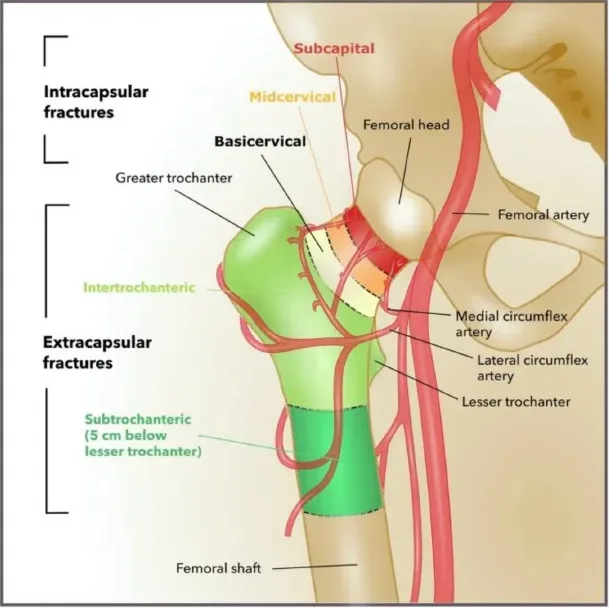
Geriatric hip fracture management is the coordinated care of an older adult with a proximal femoral fracture, from diagnosis and surgery through rehabilitation and prevention of another fall. The operation matters. So does every decision around it. A femoral neck fracture sits within the joint capsule; an intertrochanteric or subtrochanteric injury lies outside it. That difference changes the problem. Displacement of the neck can compromise the blood supply to the femoral head, while fractures lower down raise different questions about load, stability and fixation. Frail bone adds another constraint. A familiar implant cannot make these distinctions disappear. For clinical teams, the first task is to describe the injury and the person who sustained it. For distributors and hospital buyers, the lesson is equally clear: stock a system around the hospital's treatment needs, rather than treating every hip fracture as a nail order.
Anatomy figure from the supplied source article: intracapsular and extracapsular fracture regions.
2. Classify the fracture and resolve diagnostic doubt
Fracture classification should explain what the team must decide next. Garden I and II describe incomplete or complete nondisplaced femoral neck injuries; III and IV describe increasing displacement. This is useful language, but a classification label is not a complete treatment plan. The actual images, fracture alignment and patient's condition still matter. Persistent hip pain after a fall also deserves attention when initial radiographs appear normal. NICE recommends MRI for a suspected occult hip fracture despite adequate negative X-rays, with CT considered when MRI is unavailable within 24 hours or contraindicated. Do not turn an uncertain image into a confident discharge decision. In geriatric hip fracture management, the handover should state the fracture location, displacement and remaining uncertainty. A clear description helps the next clinician act; a vague note that says only “hip fracture” leaves too much unresolved for the team.
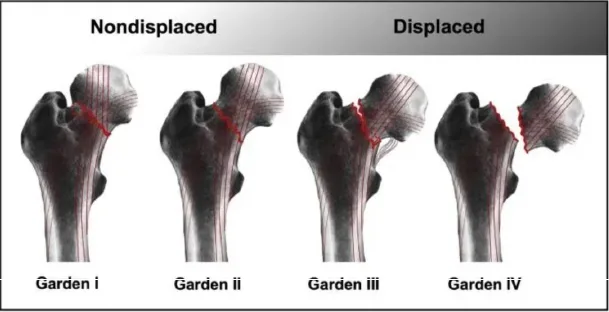
Original Garden classification illustration: nondisplaced versus displaced femoral neck fractures.
3. Prepare promptly and treat the whole patient
A birth date does not describe a patient's reserve. Frailty, baseline mobility and cognition help explain how much support that person may need. Ask what walking looked like before the fall. Establish who manages medicines, whether the patient lives alone, and what help is already in place. These details make the eventual recovery goal more realistic. Meanwhile, pain relief, hydration and correction of reversible problems need a named owner. An incomplete handover can waste time even when every department is working hard. NICE advises surgery on the day of admission or the following day, alongside prompt treatment of correctable comorbidities. Geriatric hip fracture management therefore needs an agreed pathway between orthopedics, anesthesia, nursing and geriatric medicine. Readiness means resolving the issues that genuinely affect care and documenting the remaining risks. A long list of routine tasks, without priorities or responsibility, is not a plan.
4. Make bleeding and medication risks explicit
Blood loss can be easy to underestimate when the wound is closed. Medication reconciliation belongs near the start of assessment: record the anticoagulant or antiplatelet drug, indication, last dose and relevant renal function. A generic instruction to stop every drug for the same interval cannot account for these differences. The anesthesia and surgical teams need a shared plan that balances bleeding, thrombosis and delay. AAOS recommends tranexamic acid to reduce blood loss and transfusion in hip fracture patients, as well as venous thromboembolism prophylaxis. Selection and timing should follow patient assessment and local protocols. For geriatric hip fracture management, the practical failure is often a missing decision: who reviewed the medicines, who will reassess blood loss, and who owns the postoperative prevention plan? Write those answers down. They are more useful than a copied table with no connection to the patient in front of the team.
5. Look for quiet delirium as well as agitation
A withdrawn patient can be overlooked while an agitated patient attracts immediate attention. Hypoactive delirium may present with slower responses, reduced movement or a new loss of engagement. Compare today's behavior with the person's usual state; family members can help establish that baseline. NICE recommends assessment with the 4AT when delirium indicators are present, with different tools used in critical care or postoperative recovery. Prevention and management include orientation, access to glasses and hearing aids, attention to hydration and nutrition, sleep protection and review of medicines. Look for underlying causes rather than treating a change in behavior as inevitable aging. Geriatric hip fracture management is harder when pain, confusion and poor communication reinforce one another. Give staff a consistent way to record changes and escalate concerns. “Quiet overnight” is not enough if the person is newly unable to follow a simple conversation.
6. Match surgery and equipment to the fracture pattern
No single implant fits every proximal femoral fracture. AAOS guidance favors arthroplasty over fixation for displaced femoral neck fractures in older adults. For stable intertrochanteric fractures, its guidance supports either a sliding hip screw or a cephalomedullary device; for reverse-obliquity and subtrochanteric fractures, it recommends a cephalomedullary device. These distinctions should shape both clinical discussions and purchasing requests. Hospitals assessing nail options can review the PFNA Gamma Interlocking Nail System II and confirm the exact configuration against their surgeon-approved requirements. A catalogue image cannot establish suitability for an individual case. Geriatric hip fracture management also depends on the matching blades or screws, end caps, targeting tools and extraction equipment being available. Before approving a supply order, reconcile the implant list with the instrument list and the current instructions for use. A missing component is a supply failure that should be found before the operating room needs it.
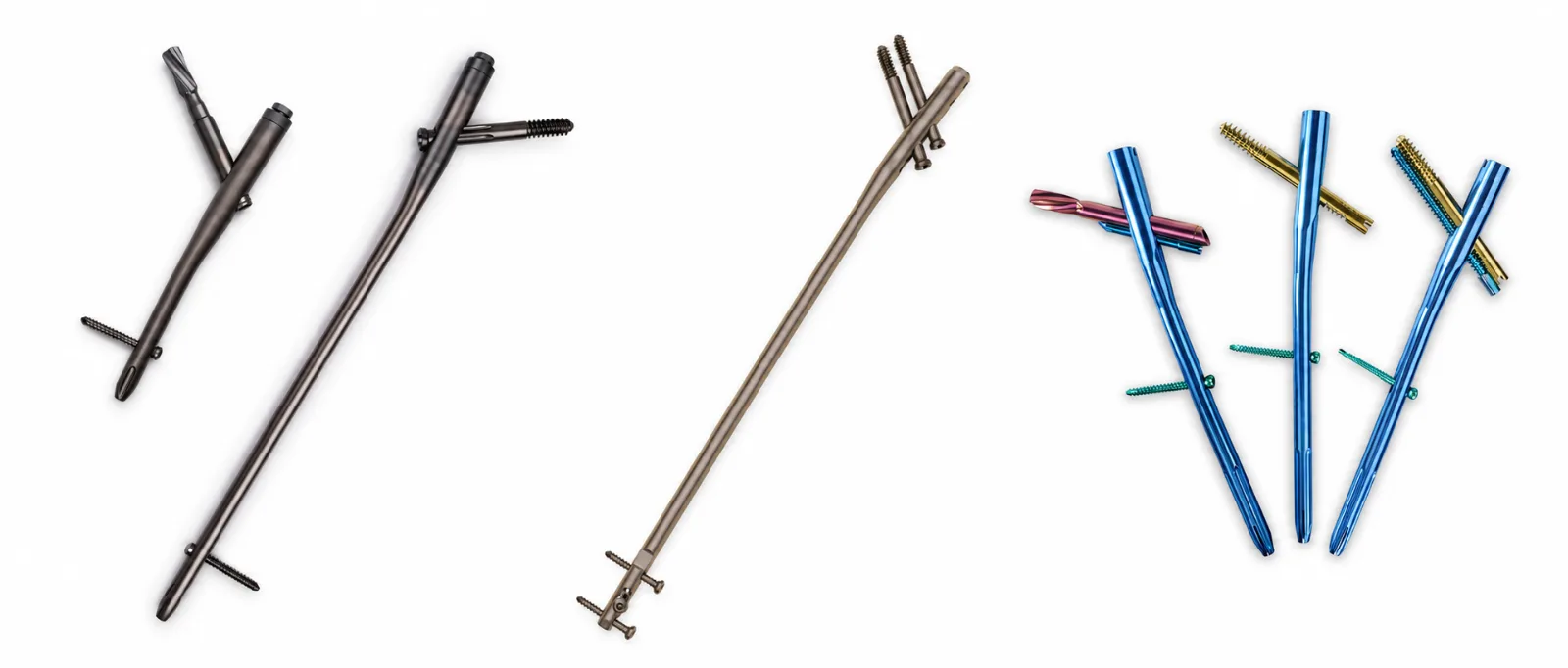
Product reference for procurement review. Implant selection remains fracture-specific.
- Confirm the requested nail model, side, length and diameter.
- Verify compatible fixation components and the complete instrument set.
- Review traceability, documentation and replenishment arrangements.
7. Plan recovery before discharge becomes urgent
A technically completed operation is one milestone. Recovery needs its own plan. Patients and carers need to know what movement is permitted, how pain will be managed, and who to contact when progress stalls. NICE recommends mobilization on the day after surgery unless medically or surgically contraindicated, with regular physiotherapy review. Weight-bearing instructions must reflect the procedure and the treating team's assessment. Nutrition, skin care, falls assessment and bone health follow-up belong in the same conversation. Geriatric hip fracture management should connect the ward, rehabilitation team and home setting, so responsibilities do not disappear at discharge. For example, a patient who previously walked independently but now needs assistance requires more than a prescription and a date for review. Document the next mobility goal, the help available and the follow-up arrangements. Restoring function takes coordination long after the implant has been placed.
What hospital buyers and distributors should take from this
A credible hip fracture service needs a complete, traceable supply system that supports the clinical pathway. Buying a nail alone does not achieve that. Ask the hospital which fracture patterns its teams treat, which systems they use, and which instruments must accompany each configuration. Then compare the proposed implant list with the trauma instrument systems and request a model-specific compatibility review. Confirm sizes, component codes, reusable instrument instructions, replacement arrangements and market documentation before making a purchasing commitment. For procurement teams supporting geriatric hip fracture management, a useful enquiry states the country, required configuration, quantities and delivery window. That gives the supplier something concrete to assess. The seven priorities above all point to the same conclusion: the quality of the pathway matters as much as the availability of the device. Start with a defined clinical need, then verify the equipment and support required to meet it.
Editorial source: the supplied article “老年股骨近端骨折的7大重点,看你做到了哪一步?” by Dr. Peng / 骨今中外. Clinical statements were cross-checked against the linked NICE and AAOS guidance. Source illustrations are reproduced without redrawing anatomical details.