
Fan Zhendong visited MEDICA 2026 with Borussia Düsseldorf, linking elite sport, healthcare innovation and China-Germany business.
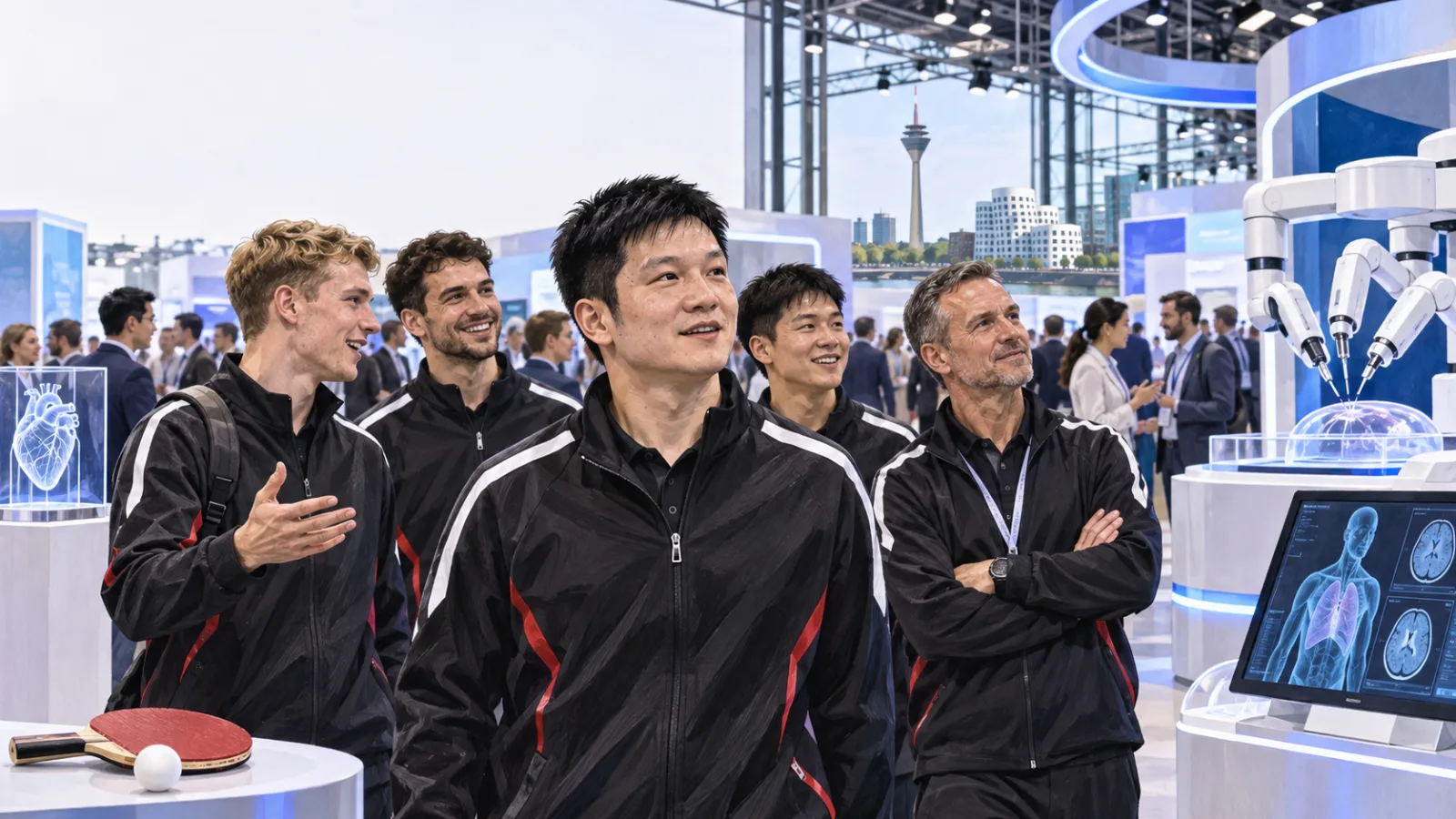
Fan Zhendong at MEDICA 2026 was never just a celebrity walk-through. On 17 November, the Olympic table tennis champion joined Borussia Düsseldorf teammates and club staff at the medical technology exhibition in Düsseldorf. Chinese exhibitors and fans quickly turned the visit into a social-media moment, but the sharper story sits behind the camera phones. This was a sponsor-linked club appearance at a trade fair built around international business, clinical technology and cross-border networks. In that setting, Fan did not need a sales script. His presence carried Chinese attention into a German B2B venue and gave an otherwise technical event a human point of entry. That is precisely why the visit worked. It connected elite sport, healthcare innovation and commerce without pretending they are the same thing. Brands should notice the distinction: borrowed fame creates noise; credible context creates relevance.
Fan Zhendong at MEDICA 2026 Was a Club Activity, Not a Random Stunt
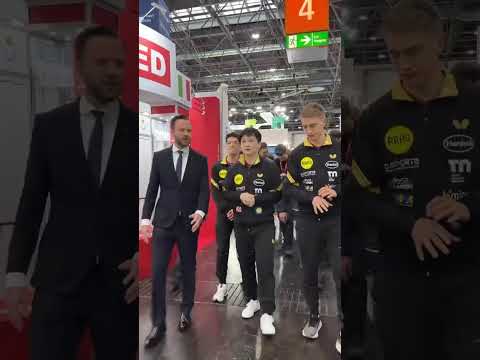
Fan attended with Borussia Düsseldorf, including teammates associated with the club’s 2026/27 roster, rather than arriving as a solo influencer. That detail matters. Messe Düsseldorf has a long-running relationship with the table tennis club, so the appearance had an institutional reason to exist. Chinese reports and attendee footage showed the group moving through the exhibition, speaking with one another, joining light table tennis interactions and attracting a dense ring of spectators. The easy headline is “Olympic champion causes a stir.” The more useful conclusion is harder: this was disciplined sponsorship activation. It placed a recognised athlete inside a partner’s core business environment and allowed the venue, club and exhibitors to share attention. There is no evidence that Fan endorsed a specific medical device. Treating the visit as a product testimonial would be sloppy. Its value came from association, access and cultural reach.
Why MEDICA 2026 Was the Right Stage
MEDICA is not a lifestyle expo decorated with a few medical gadgets. The official organiser described the 2026 edition, held from 16 to 19 November, as a platform where healthcare decision-makers confront digitalisation, artificial intelligence, workforce pressure and the practical integration of technology into care. Several thousand companies from dozens of countries were scheduled to exhibit, while more than 900 speakers were attached to the programme. That scale explains the response to the Borussia Düsseldorf visit. The halls already contained an unusually international audience; Fan supplied a sudden point of shared recognition. For Chinese medical-device manufacturers, distributors and visitors, the encounter compressed distance. A German club, a global healthcare marketplace and a Chinese sporting figure became visible in one frame. It was brief, but commercially legible.
Medical Robotics Gave the Visit More Than Visual Novelty
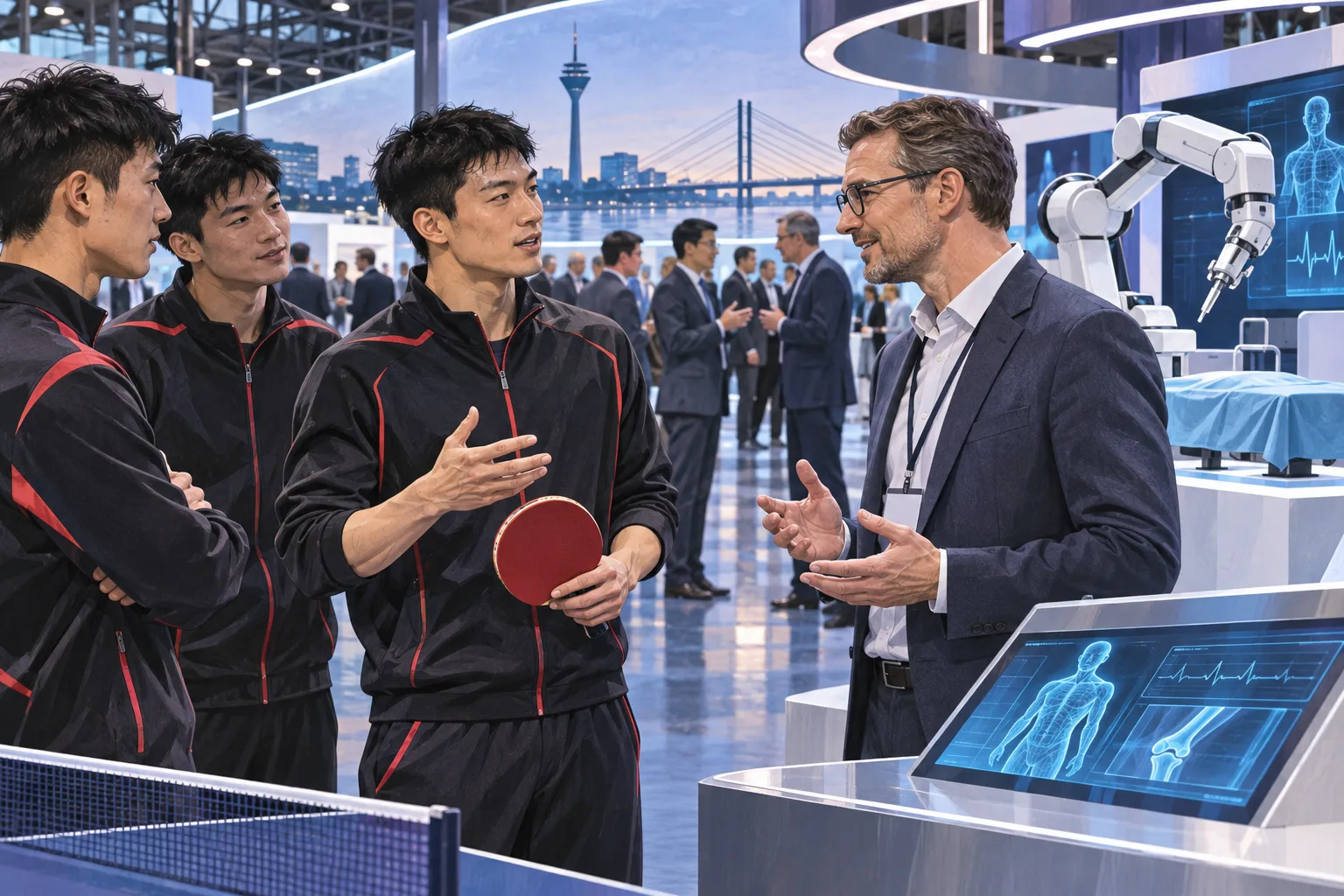
Media accounts highlighted stops around automation and medical robotics, areas that naturally produce striking video. Yet the appeal was not merely mechanical theatre. Robotics, AI-assisted diagnostics and connected care sit near the centre of the industry’s current argument: a clever prototype is worthless if hospitals cannot integrate it safely, economically and repeatedly. MEDICA’s own 2026 positioning stressed relevance over raw size and demanded solutions that fit real care processes. Against that backdrop, an elite athlete examining robotic systems creates a useful contrast. Table tennis depends on precision, timing, feedback and relentless iteration; medical technology is judged by a far less forgiving version of the same disciplines. The comparison should not be stretched into a clinical claim. Still, it gives readers a clear way to understand why sports figures and health-technology platforms can share a stage without the pairing feeling artificial.
Chinese Exhibitors Did Not React by Accident
The crowd response around Fan Zhendong’s MEDICA visit exposed a fact many trade-show marketers prefer to ignore: people remember people before they remember booth architecture. Chinese exhibitors reportedly called out to him, filmed the group and shared the encounter online. Their enthusiasm did not reduce the seriousness of the fair; it widened its reach beyond visitors already inside the halls. Fan’s move to Borussia Düsseldorf had already multiplied the club’s international attention. Xinhua reported in August that club manager Andreas Preuss saw a dramatic rise in social-media interest, media coverage, supporters and sponsors after the signing. At MEDICA, that attention became physical. For a few minutes, the exhibition floor acted as a live bridge between Chinese digital audiences and German institutional networks. Expensive stand design alone rarely buys that kind of emotional transmission.
The Commercial Logic Was Stronger Than the Celebrity Optics
Lazy event marketing starts with a famous face and searches for a justification afterward. This activation worked in the opposite direction. The Düsseldorf venue group, its international operations and Borussia Düsseldorf already occupied overlapping civic and commercial territory. Fan added reach in China, sporting authority and a new audience without changing the event’s professional purpose. The resulting value moved in several directions:
- MEDICA gained attention from audiences outside conventional healthcare media.
- Borussia Düsseldorf demonstrated sponsor value beyond match-day exposure.
- Exhibitors received an organic social moment inside a highly technical setting.
- Chinese viewers saw Düsseldorf as a place where sport, industry and international exchange meet.
None of this required a forced product pitch. In fact, a catalogue in Fan’s hands would probably have made the scene less credible. The activation succeeded because the relationship was visible while the sales machinery stayed backstage.
What Medical-Device Brands Should Learn From the Visit
The lesson is not “hire an Olympic champion.” Most companies cannot, and many should not. The lesson is to build relevance before buying reach. A medical-device company preparing for a major exhibition should identify one verified audience problem, one demonstrable capability and one person who can explain the connection without inflated claims. For a trauma fixation supplier, that might mean showing how an instrument set reduces complexity for distributors or how a modular external fixation system supports inventory planning. It does not mean attaching a celebrity to an unqualified promise. Strong trade-show content answers three questions quickly: Who is this for? What operational problem does it solve? What should the buyer verify next? The Düsseldorf appearance generated attention because its context was already coherent. Product marketers must earn the same coherence through evidence, not applause.
A China-Germany Business Bridge, Built in Real Time
Fan’s presence also carried meaning beyond sport. He is a Chinese Olympic champion competing for one of Germany’s most recognisable table tennis clubs, in a city whose exhibition business connects companies across continents. When Chinese attendees recognised him inside the halls, the abstract phrase “China-Germany exchange” became immediate and personal. The rain-soaked departure footage shared by media—Fan leaving under an umbrella with a MEDICA China representative—added a warm closing image, but the commercial substance came earlier. International business grows through repeated contact, trusted institutions and moments that make unfamiliar networks feel accessible. A single visit cannot create a market. It can, however, lower the psychological distance between markets. That is a more durable outcome than a trending clip, and a more honest one.
What the MEDICA Appearance Really Signaled
Fan Zhendong at MEDICA 2026 showed how sponsorship can operate when the setting, people and audience genuinely fit. The visit brought warmth to a technical trade fair, international visibility to a club partnership and a familiar cultural reference to Chinese exhibitors far from home. It also drew a clean boundary. Fan was a guest and club member, not proof of a device’s performance. MEDICA remained a business platform, not a fan convention. That balance is exactly what made the moment effective. Healthcare brands chasing attention should resist the temptation to copy its surface. Do not start with fame, a camera crew or a giant slogan. Start with a credible relationship and a reason for the audience to care. Attention follows meaning far more reliably than meaning follows attention.
Frequently Asked Questions
When did Fan Zhendong visit MEDICA 2026?
He visited the Düsseldorf exhibition on 17 November 2026 as part of a Borussia Düsseldorf club delegation during MEDICA, which ran from 16 to 19 November.
Was Fan Zhendong endorsing a medical-device brand?
No specific product endorsement has been established. Available reporting describes a club and sponsor-linked exhibition visit. Any stronger claim would need direct confirmation from the athlete, club or brand.
Why was the appearance important for Chinese exhibitors?
It created a highly shareable point of recognition inside a global B2B setting and highlighted the city’s role in connecting Chinese audiences, German institutions and the international medical-technology industry.
Image disclosure: The accompanying visuals are editorial illustrations created for this analysis; they are not photographs of the event.
Share this
Facebook · LinkedIn · Twitter / X · VK · Threads
More social platforms: Instagram · YouTube · TikTok · Snapchat